 Add to Chrome
 Add to Firefox
 Add to Edge
DirectorBench: Diagnosing Long-Form Video Generation with Personalized Multi-Agent Evaluation
May 28, 2026
Long-form video generation is rapidly moving from short, single-scene synthesis toward minute-long, multi-shot creation with narrative structure, cinematic control, audio, and cross-modal synchronization. However, evaluating such videos remains challenging, since existing benchmarks largely focus on local visual quality, short-horizon temporal consistency, or generic prompt alignment, and provide limited diagnosis of workflow failures and user-dependent preferences. We introduce DirectorBench, a personalized multi-agent diagnostic benchmark for long-form video generation. DirectorBench evaluates generated videos with respect to 80 structured metadata entries, 7 user profiles, and 40 checkpoint criteria across 5 dimensions: script, visual, audio, cross-modal, and stability. Instead of reducing quality to a single aggregate score, DirectorBench localizes checkpoint-level bottlenecks and supports profile-aware evaluation. We evaluate 4 long-form video generation workflows, 6 base LLMs, and 7 user profiles. Across workflows, DirectorBench reveals a between-unit bottleneck: transition quality averages only 0.256 and reaches 0.356 for the best workflow, while prompt-level user demand fulfillment averages 0.71. We further conduct human evaluation with 14 annotators to validate the alignment between DirectorBench and human judgment. The results show that DirectorBench captures human-perceptible quality differences and reveals workflow- and profile-dependent failure modes that are hidden by aggregate scoring. These findings highlight the importance of diagnostic and profile-aware benchmarking for long-form video generation.

AssetGen: Deployable 3D Asset Generation at Interactive Speed
May 22, 2026While 3D generation is progressing rapidly, recent work has often focused on obtaining high-resolution assets, leaving user experience and deployability as afterthoughts. We present AssetGen, a 3D generator that focuses instead on these two aspects. Given one reference image, in 30 seconds it produces a high-quality mesh with baked normals, a color texture, and a controlled polygon budget suitable for real-time rendering, including mobile use cases. The AssetGen Flash variant further reduces latency to 14 seconds for interactive and agentic creation loops. Our model generates the object geometry with a coarse-to-refine VecSet framework, which implements mesh simplification, cleaning, and normal baking on the GPU, and a fast parallel UV unwrapping. It then generates textures in a multi-view fashion, followed by backprojection and 3D inpainting. Model distillation, kernel optimization, and pipeline parallelization are co-designed to accelerate the system end-to-end. We introduce numerous automated and blind human evaluations and demonstrate competitive visual quality against leading commercial solutions in 30 seconds and preview-quality results in less than 15 seconds. The final result is a system that supports AI-assisted, deployable 3D content creation in interactive workflows.
REFLECTOR: Internalizing Step-wise Reflection against Indirect Jailbreak
May 20, 2026While Large Language Models (LLMs) demonstrate remarkable capabilities, they remain susceptible to sophisticated, multi-step jailbreak attacks that circumvent conventional surface-level safety alignment by exploiting the internal generation process. To address these vulnerabilities, we propose Reflector, a principled two-stage framework that internalizes self-reflection within the generation trajectory. Reflector first leverages teacher-guided generation to produce high-quality reflection data for supervised fine-tuning (SFT), establishing structured reflection patterns. It subsequently uses Reinforcement Learning (RL) with outcome-driven and reward-validity supervision to instill robust, autonomous self-reflection capabilities. Empirical results show that Reflector achieves Defense Success Rates (DSR) exceeding 90% against complex indirect attacks while generalizing robustly across diverse threat scenarios. Notably, the framework enhances both task-specific and general utility, yielding a 5.85% gain on GSM8K alongside improved performance on knowledge-intensive benchmarks. By internalizing trajectory-level safety, Reflector overcomes the fundamental limitations of surface alignment without significant computational overhead, offering an efficient and scalable solution for the development of safe and capable LLMs.
TGPP: Trajectory-Guided Plug-and-Play Priors for Sparse Radio Map Reconstruction
May 07, 2026Radio map (RM) reconstruction is essential for environment-aware wireless networks, but practical measurements are often collected along mobility trajectories rather than randomly scattered over the target region. Such trajectory-sampled observations induce spatially heterogeneous uncertainty: near-trajectory regions are directly constrained, whereas distant or occluded regions remain weakly observed, leading to degraded reconstruction accuracy in under-constrained areas. To address this problem, we propose Trajectory-Guided Plug-and-Play Priors (TGPP), a general guidance module for sparse RM reconstruction. TGPP learns an explicit guidance map as an interpretable input-space risk prior, and an implicit guide feature that is projected and fused with backbone hidden representations. TGPP can be attached to different reconstruction backbones without changing their original task formulation. We further introduce RadioFlow-LDM, a latent flow-based generative backbone, and apply TGPP to deterministic, adversarial, graph-based, and latent generative reconstruction models. Experiments on RadioMapSeer with five trajectory sampling rates show that trajectory-sampled reconstruction differs substantially from random sparse interpolation. TGPP improves most reconstruction metrics across backbones, achieving up to 43.1% NMSE reduction relative to the corresponding base backbone without trajectory-guided priors.
Mind Your HEARTBEAT! Claw Background Execution Inherently Enables Silent Memory Pollution
Mar 25, 2026We identify a critical security vulnerability in mainstream Claw personal AI agents: untrusted content encountered during heartbeat-driven background execution can silently pollute agent memory and subsequently influence user-facing behavior without the user's awareness. This vulnerability arises from an architectural design shared across the Claw ecosystem: heartbeat background execution runs in the same session as user-facing conversation, so content ingested from any external source monitored in the background (including email, message channels, news feeds, code repositories, and social platforms) can enter the same memory context used for foreground interaction, often with limited user visibility and without clear source provenance. We formalize this process as an Exposure (E) $\rightarrow$ Memory (M) $\rightarrow$ Behavior (B) pathway: misinformation encountered during heartbeat execution enters the agent's short-term session context, potentially gets written into long-term memory, and later shapes downstream user-facing behavior. We instantiate this pathway in an agent-native social setting using MissClaw, a controlled research replica of Moltbook. We find that (1) social credibility cues, especially perceived consensus, are the dominant driver of short-term behavioral influence, with misleading rates up to 61%; (2) routine memory-saving behavior can promote short-term pollution into durable long-term memory at rates up to 91%, with cross-session behavioral influence reaching 76%; (3) under naturalistic browsing with content dilution and context pruning, pollution still crosses session boundaries. Overall, prompt injection is not required: ordinary social misinformation is sufficient to silently shape agent memory and behavior under heartbeat-driven background execution.
Understanding and Preserving Safety in Fine-Tuned LLMs
Jan 15, 2026Fine-tuning is an essential and pervasive functionality for applying large language models (LLMs) to downstream tasks. However, it has the potential to substantially degrade safety alignment, e.g., by greatly increasing susceptibility to jailbreak attacks, even when the fine-tuning data is entirely harmless. Despite garnering growing attention in defense efforts during the fine-tuning stage, existing methods struggle with a persistent safety-utility dilemma: emphasizing safety compromises task performance, whereas prioritizing utility typically requires deep fine-tuning that inevitably leads to steep safety declination. In this work, we address this dilemma by shedding new light on the geometric interaction between safety- and utility-oriented gradients in safety-aligned LLMs. Through systematic empirical analysis, we uncover three key insights: (I) safety gradients lie in a low-rank subspace, while utility gradients span a broader high-dimensional space; (II) these subspaces are often negatively correlated, causing directional conflicts during fine-tuning; and (III) the dominant safety direction can be efficiently estimated from a single sample. Building upon these novel insights, we propose safety-preserving fine-tuning (SPF), a lightweight approach that explicitly removes gradient components conflicting with the low-rank safety subspace. Theoretically, we show that SPF guarantees utility convergence while bounding safety drift. Empirically, SPF consistently maintains downstream task performance and recovers nearly all pre-trained safety alignment, even under adversarial fine-tuning scenarios. Furthermore, SPF exhibits robust resistance to both deep fine-tuning and dynamic jailbreak attacks. Together, our findings provide new mechanistic understanding and practical guidance toward always-aligned LLM fine-tuning.
Safety at One Shot: Patching Fine-Tuned LLMs with A Single Instance
Jan 06, 2026Fine-tuning safety-aligned large language models (LLMs) can substantially compromise their safety. Previous approaches require many safety samples or calibration sets, which not only incur significant computational overhead during realignment but also lead to noticeable degradation in model utility. Contrary to this belief, we show that safety alignment can be fully recovered with only a single safety example, without sacrificing utility and at minimal cost. Remarkably, this recovery is effective regardless of the number of harmful examples used in fine-tuning or the size of the underlying model, and convergence is achieved within just a few epochs. Furthermore, we uncover the low-rank structure of the safety gradient, which explains why such efficient correction is possible. We validate our findings across five safety-aligned LLMs and multiple datasets, demonstrating the generality of our approach.
Are Time-Series Foundation Models Deployment-Ready? A Systematic Study of Adversarial Robustness Across Domains
May 26, 2025Time Series Foundation Models (TSFMs), which are pretrained on large-scale, cross-domain data and capable of zero-shot forecasting in new scenarios without further training, are increasingly adopted in real-world applications. However, as the zero-shot forecasting paradigm gets popular, a critical yet overlooked question emerges: Are TSFMs robust to adversarial input perturbations? Such perturbations could be exploited in man-in-the-middle attacks or data poisoning. To address this gap, we conduct a systematic investigation into the adversarial robustness of TSFMs. Our results show that even minimal perturbations can induce significant and controllable changes in forecast behaviors, including trend reversal, temporal drift, and amplitude shift, posing serious risks to TSFM-based services. Through experiments on representative TSFMs and multiple datasets, we reveal their consistent vulnerabilities and identify potential architectural designs, such as structural sparsity and multi-task pretraining, that may improve robustness. Our findings offer actionable guidance for designing more resilient forecasting systems and provide a critical assessment of the adversarial robustness of TSFMs.
SHAPE : Self-Improved Visual Preference Alignment by Iteratively Generating Holistic Winner
Mar 06, 2025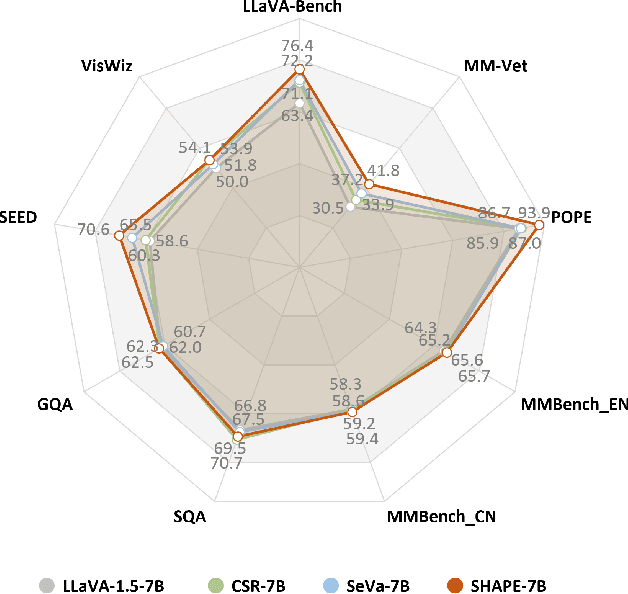
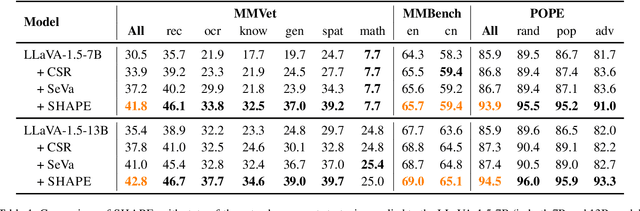
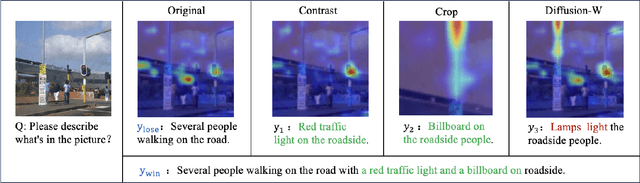
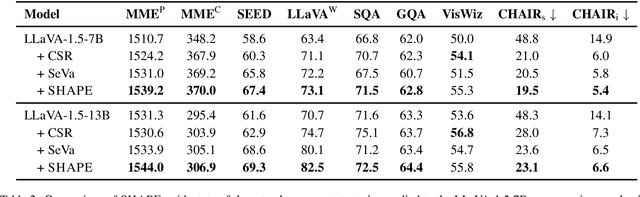
Large Visual Language Models (LVLMs) increasingly rely on preference alignment to ensure reliability, which steers the model behavior via preference fine-tuning on preference data structured as ``image - winner text - loser text'' triplets. However, existing approaches often suffer from limited diversity and high costs associated with human-annotated preference data, hindering LVLMs from fully achieving their intended alignment capabilities. We present \projectname, a self-supervised framework capable of transforming the already abundant supervised text-image pairs into holistic preference triplets for more effective and cheaper LVLM alignment, eliminating the need for human preference annotations. Our approach facilitates LVLMs in progressively enhancing alignment capabilities through iterative self-improvement. The key design rationale is to devise preference triplets where the winner text consistently improves in holisticness and outperforms the loser response in quality, thereby pushing the model to ``strive to the utmost'' of alignment performance through preference fine-tuning. For each given text-image pair, SHAPE introduces multiple visual augmentations and pairs them with a summarized text to serve as the winner response, while designating the original text as the loser response. Experiments across \textbf{12} benchmarks on various model architectures and sizes, including LLaVA and DeepSeek-VL, show that SHAPE achieves significant gains, for example, achieving +11.3\% on MMVet (comprehensive evaluation), +1.4\% on MMBench (general VQA), and +8.0\% on POPE (hallucination robustness) over baselines in 7B models. Notably, qualitative analyses confirm enhanced attention to visual details and better alignment with human preferences for holistic descriptions.
Unify and Anchor: A Context-Aware Transformer for Cross-Domain Time Series Forecasting
Mar 03, 2025The rise of foundation models has revolutionized natural language processing and computer vision, yet their best practices to time series forecasting remains underexplored. Existing time series foundation models often adopt methodologies from these fields without addressing the unique characteristics of time series data. In this paper, we identify two key challenges in cross-domain time series forecasting: the complexity of temporal patterns and semantic misalignment. To tackle these issues, we propose the ``Unify and Anchor" transfer paradigm, which disentangles frequency components for a unified perspective and incorporates external context as domain anchors for guided adaptation. Based on this framework, we introduce ContexTST, a Transformer-based model that employs a time series coordinator for structured representation and the Transformer blocks with a context-informed mixture-of-experts mechanism for effective cross-domain generalization. Extensive experiments demonstrate that ContexTST advances state-of-the-art forecasting performance while achieving strong zero-shot transferability across diverse domains.